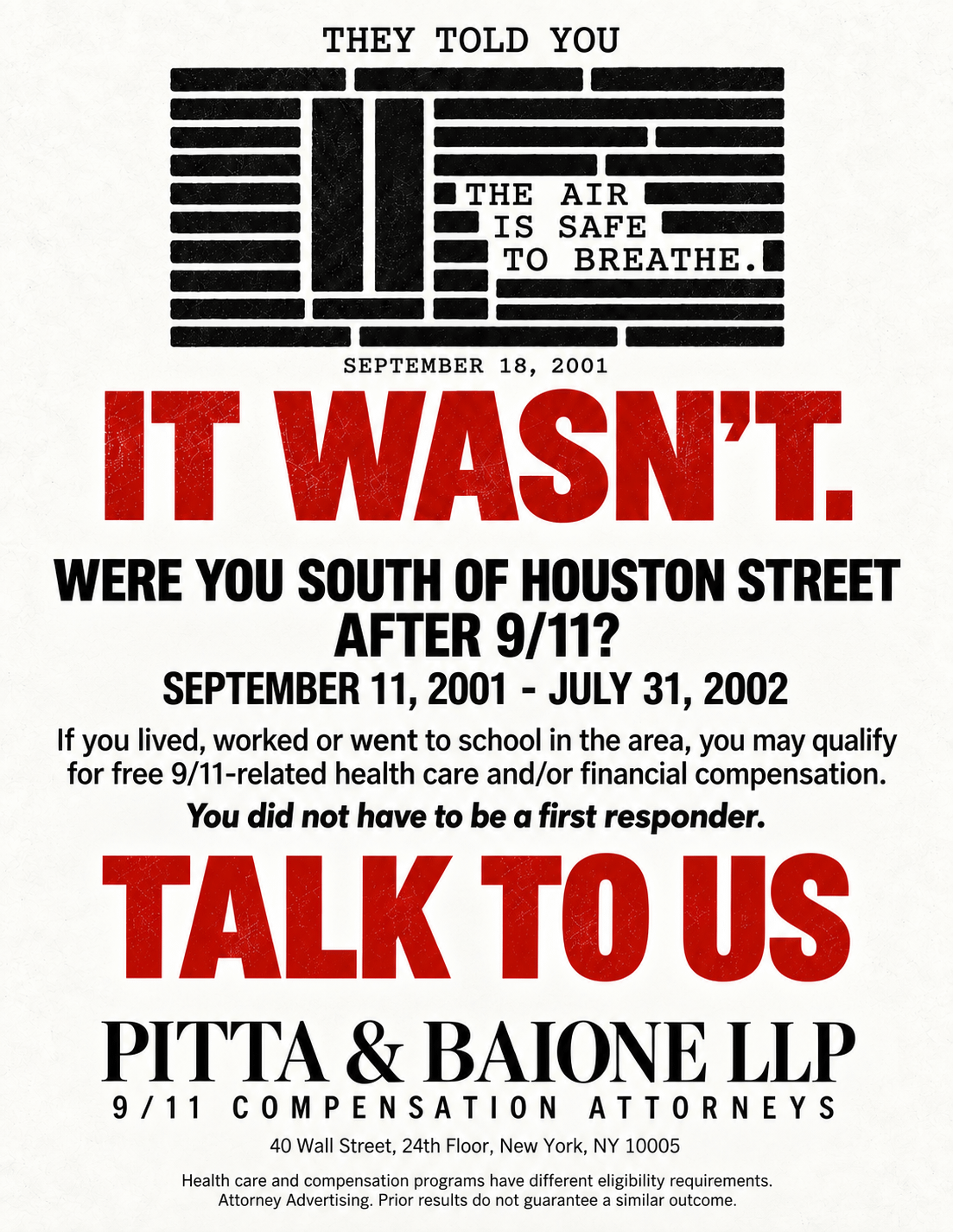
September 11, 2001 is the date everyone knows, but for hundreds of thousands of people who lived, worked, and went to school in Lower Manhattan during that time, September 18 may actually be the date that changed their health forever. That was the day the federal government “confirmed” the air was safe to breathe. It was not.
Twenty-five years ago this week, one week after the towers fell, the U.S. Environmental Protection Agency (EPA) issued a press release reassuring New Yorkers that the air around Ground Zero was safe. That sentiment sent office workers back to their desks, students back to their classrooms, and residents back to apartments that were still coated in toxic materials. A quarter-century later, we now know that the reassurance came before the science did, and the people who heeded the EPA’s advice back in 2001 are still paying the price today.
At Pitta & Baione LLP, we represent individuals who were harmed by that toxic exposure. On the 25th anniversary of the issuance of the EPA’s “safe to breathe” advisory statement, we want to make sure this date, and what it set in motion, is not forgotten.
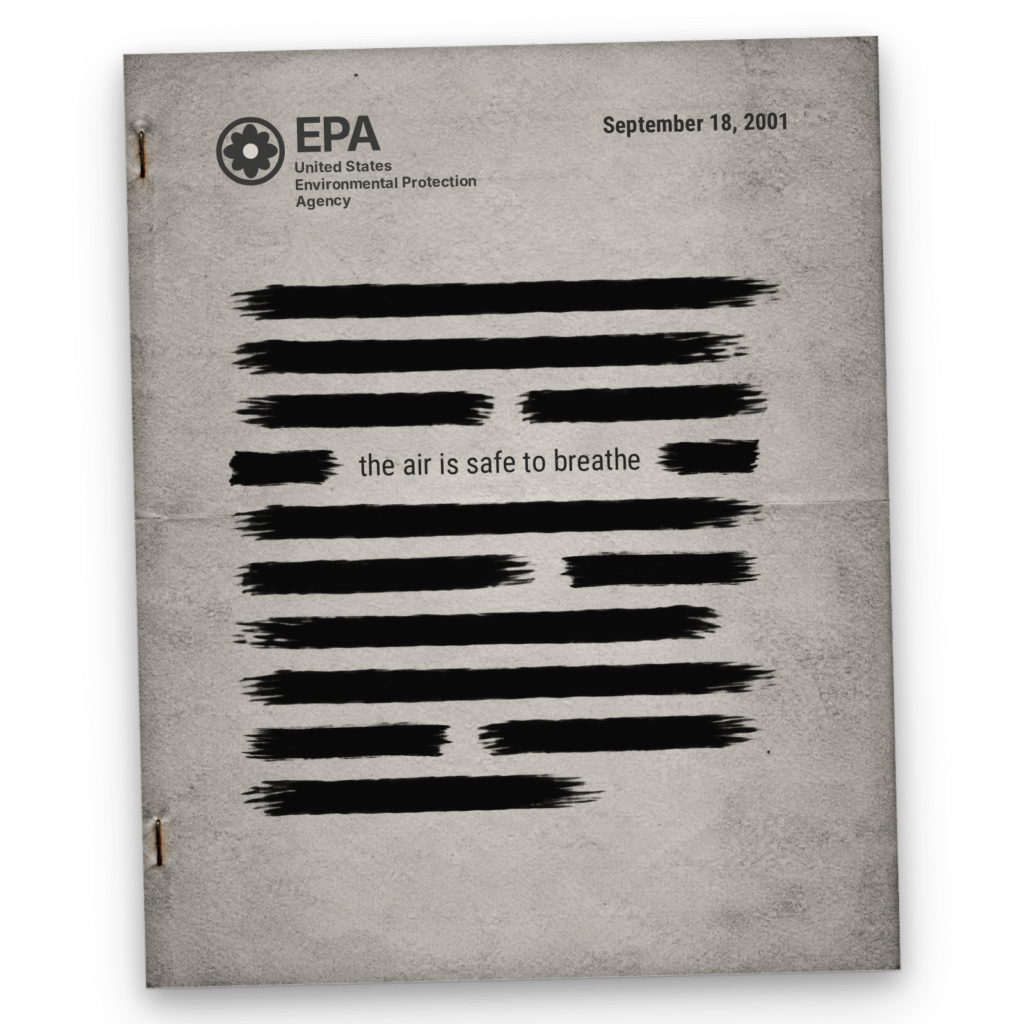
September 18, 2001: “Their Air Is Safe to Breathe”
One week after the terrorist attacks, then-EPA Administrator and former New Jersey Governor Christie Whitman announced in an official agency press release that monitoring showed the public was not being exposed to dangerous levels of contaminants. In her own words, she said she was glad to reassure the people of New York and Washington, D.C. that their air was “safe to breathe” and their water was “safe to drink.”
Her statement became the government’s official message. It was repeated, quoted, and relied upon by the tens of thousands of people who were concerned as to whether it was safe to live and work in lower Manhattan. Whitman’s words served as the green light they had been desperately waiting for.
The problem, though, is that it was not backed by any empirical data. The all-clear announcement came first, but the science came much later. One week after the terrorist attacks, the EPA did not yet have monitoring results for many of the contaminants of concern, and the sampling for several pollutants had barely begun.
What the Government Knew…and What It Didn’t
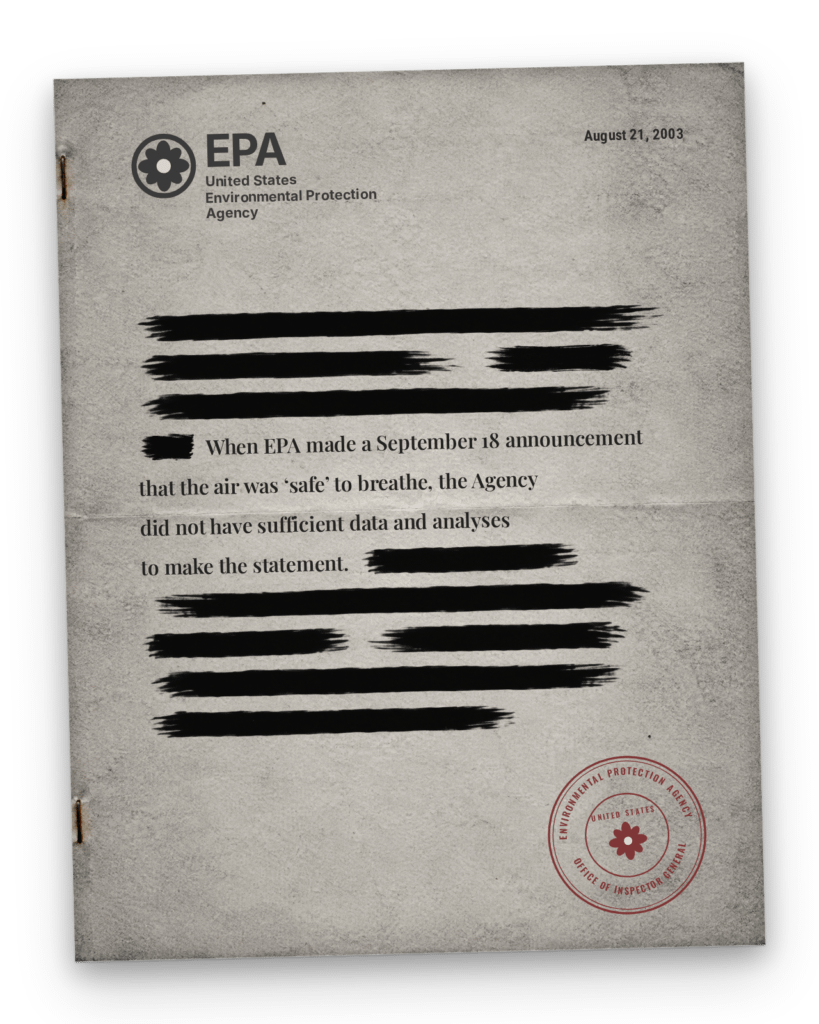
It wasn’t until two years later that the Office of the Inspector General delivered a stunning verdict. In an August 2003 report, the EPA Office of Inspector General determined that when the agency issued its September 18 announcement that the air was “safe” to breathe, it “did not have sufficient data and analyses to make such a blanket statement.”
The Inspector General’s report went further. It found that the White House Council on Environmental Quality “influenced… the information that EPA communicated to the public through its early press releases when it convinced EPA to add reassuring statements and delete cautionary ones.” Guidance that would have warned residents to, for example, have their homes professionally cleaned, and any language that would have expressed concern for more sensitive populations was softened or removed from the EPA’s statement before the public ever saw it.
The Human Cost of Misinformation
The consequences of living and working in a toxic exposure zone are not abstract. They are measured in cancers, chronic illnesses, and lives lost.
The materials that blanketed lower Manhattan were a mixture of asbestos, lead, glass fibers, pulverized concrete, and other hazardous materials, the exposure to which is now linked to dozens of cancers and respiratory conditions. These hazardous materials were present in the air for months after the initial attacks.
Today, the federally run World Trade Center Health Program (WTCHP) cares for more than 154,700 enrolled members, and has certified over 57,000 cancer cases connected to 9/11 exposure. The death toll from illnesses contracted after the 9/11 attacks has now surpassed the death toll from the attacks themselves: more than 9,400 people have died from 9/11-related illnesses, which is three times more than the 2,977 who died in the attacks on New York, at the Pentagon, and in Shanksville, Pennsylvania.
These are the people we fight for every day: office workers, building service workers, hotel and restaurant workers, teachers, students, residents, and first and secondary responders who simply lived, worked, or spent time every day in the toxic exposure zone. If you or a loved one was diagnosed with a 9/11-related illness, learn more about the covered cancers and conditions and the benefits that may be available.
A 25th-Anniversary Reckoning: 170,000 Pages Come to Light
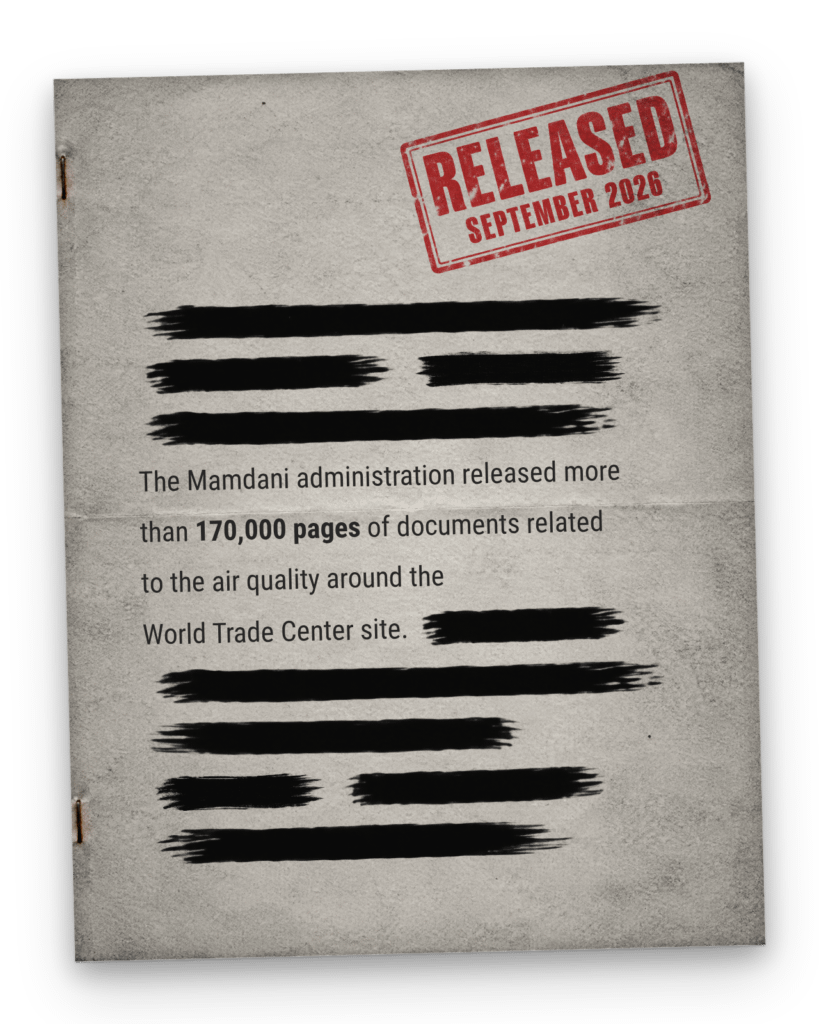
The 25th anniversary of the 9/11 terrorist attacks arrives alongside a major development in the victims’ fight for accountability. In September 2026, the administration of New York City Mayor Zohran Mamdani released more than 170,000 pages of long-sought city records related to air quality around the World Trade Center site.
The documents, drawn from city agency files, some only recently discovered in stored-away boxes, shed new light on what officials knew about the hazards in lower Manhattan and when they knew it.
“We knew the air wasn’t safe. The government at every level, from federal down to the city, knew it wasn’t safe…In 2003, the EPA already all but admitted this. The agency’s Inspector General said the EPA did not have sufficient data to declare the air was safe to breathe. The city tried to point the finger at the EPA, but it’s finally coming to the surface that the city knew the same thing the EPA knew. The air was not safe to breathe!” – Pitta & Baione LLP Partner Matthew Baione
For a community that spent more than two decades demanding answers, the information release by the Mamdani administration is a milestone. It reinforces what the members of the 9/11 community have said all along: the people who were told the air was safe to breathe deserved to be told the truth.
Why This Date Matters, and Why We Won’t Let It Be Forgotten
September 11 is seared into the nation’s memory. September 18, the day of the EPA’s flawed all-clear announcement, has no memorial, no moment of silence, no annual recognition – and that is a problem. The silence around this date is deafening. It is why so many exposed individuals still don’t realize their illness may be connected to 9/11, and why so many of them have yet to apply for, and to claim, the benefits to which they are entitled and they are owed.
Twenty-five years later, accountability is still unfolding, and the number of 9/11-related illnesses is still climbing. But two things are certain: the post-9/11 air was not safe to breathe, and help is available for those who were harmed.
If You Were There, You May Be Eligible for Free Healthcare and Compensation
“The city didn’t discriminate against who they were hiding information from, and the dust didn’t discriminate against who it was infecting. So people who were there should find out if they’re eligible. It’s not limited to responders.” – Pitta & Baione LLP Partner Matthew Baione
If you lived, worked, or attended school south of Houston Street between September 11, 2001, and July 31, 2002, you may qualify for benefits under two federal programs:
- The World Trade Center Health Program (WTCHP) provides free medical monitoring, treatment, and medication for certified 9/11-related conditions.
- The September 11th Victim Compensation Fund (VCF) provides financial compensation for physical illnesses, injuries, and deaths related to 9/11 exposure.
Not sure if you qualify? Start by reviewing our eligibility guide. Families who have lost a loved one can learn about 9/11 wrongful death claims and benefits for deceased loved ones.
Pitta & Baione LLP has recovered hundreds of millions of compensation dollars for our clients, and we’ve fought before Congress to protect the 9/11 community now and into the future. If, like so many of our clients, the government’s reassurance sent you back to live or work or visit the exposure zone and into harm’s way, let us help you get the healthcare and compensation you deserve. Contact us today for a free consultation and confidential case review.