
 Trusted Content
Key Takeaways
- There is no true “average” VCF payout, because compensation is based on the individual’s certified conditions, losses, and personal circumstances.
- VCF awards are calculated by combining economic losses and capped non-economic losses, then subtracting collateral offsets like disability benefits or insurance.
- Wrongful death claims follow a separate structure with fixed statutory non-economic awards and individualized economic loss calculations.
It depends on the unique circumstances of each claim, so the average is not a helpful indicator of what you may receive from the September 11th Victim Compensation Fund (VCF). The most common differentiators are:
- If the victim only has non-cancer conditions
- If the victim has 9/11-related cancer(s) or lung disease(s)
- If the victim died from a 9/11-related condition
- If the victim was disabled from a 9/11-related condition
In addition to these, other factors such as severity and medical expenses can factor into the VCF’s calculation.
The VCF Formula for Calculating Compensation
The basic calculation for determining an award is to take the non-economic loss (pain and suffering), add the economic loss, and subtract the collateral offsets. Collateral offsets are payments such as disability benefits, life insurance, union benefits, Social Security, Workers’ Compensation, and settlements you may have received from 9/11 related lawsuits.
Differences Between Economic and Non-Economic Losses
Economic losses and non-economic losses differ. Economic losses are losses that have a monetary amount that can be calculated based on the actual financial impact. For instance, how much a medical procedure costs or how much money or benefits you missed from being out of work due to your 9/11-related illness. Those calculations are unique to each claim, and our attorneys can assist with estimates after we gather all the required information.
Non-economic losses are based on the severity of the conditions and the negative effect on quality of life. There are strict limits on non-economic loss awards, setting maximum caps for both cancer and non-cancer conditions.
Contrary to popular belief, the VCF does not combine or “stack” awards for multiple eligible conditions. Instead, the Fund identifies the single most severe condition – or combination of conditions – that fits within the statutory guidelines and assigns a single award amount based on that severity. As a result, a victim with multiple certified conditions may receive the same award as someone with just one, if the overall impact on quality of life is determined to be similar. The following award levels reflect typical award patterns based on our firm’s experience handling thousands of VCF claims. These are not VCF-published tables, and actual awards depend on documented severity and the VCF’s individualized assessment.
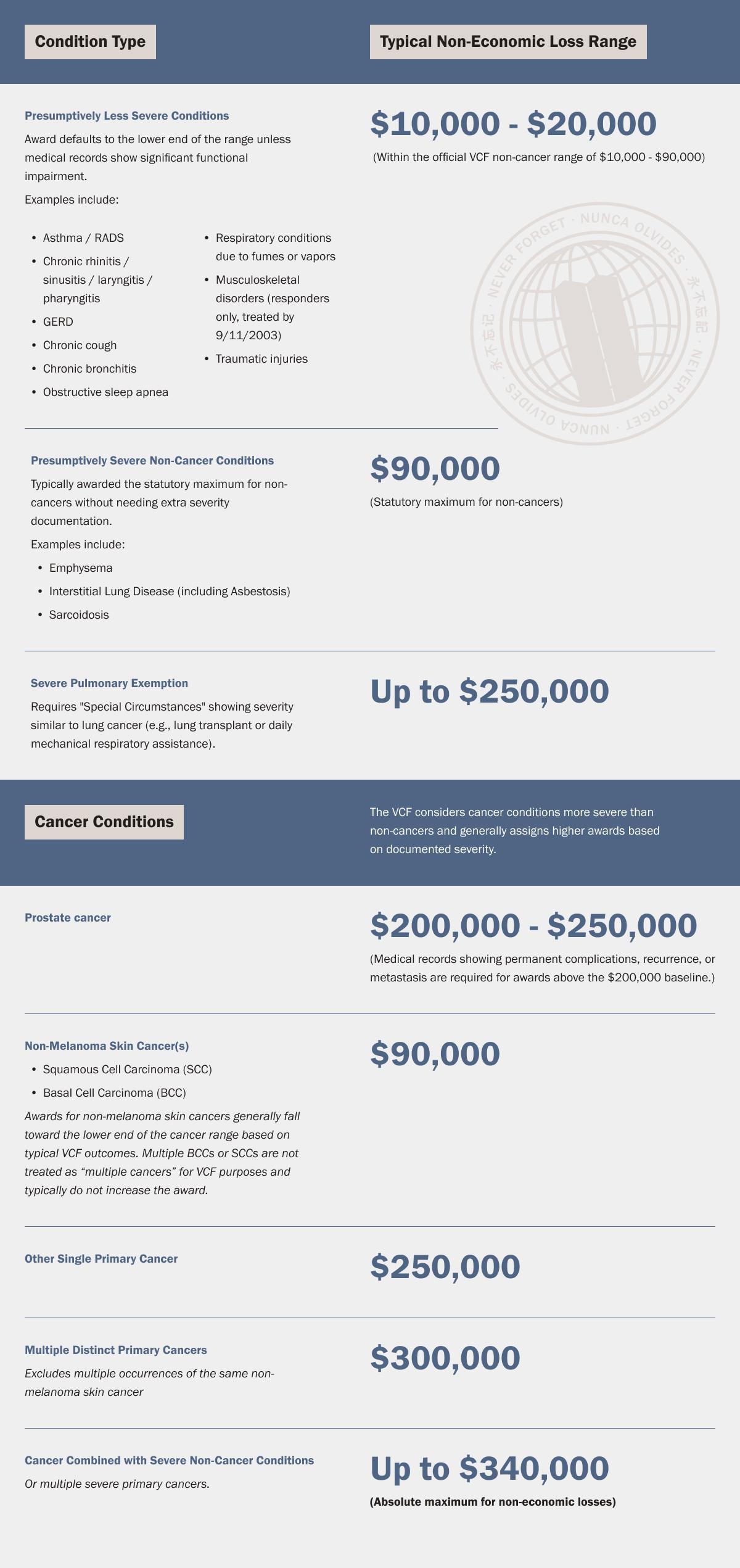
These example award amounts are based on typical outcomes we’ve seen in prior claims and are subject to change at any moment. Actual awards vary depending on medical documentation and the severity of each individual condition. For example, aerodigestive conditions with extraordinary pain and suffering, lung transplant treatment, or supplemental oxygen may warrant an increase beyond the standard award. An experienced attorney can help determine the correct amount for a non-economic loss based on current settlement awards and case law surrounding the type of injury you have had.
After determining the non-economic loss, the VCF will add economic losses such as past and future lost wages and employer-provided benefits if a short or long-term disability determination has been made due to a 9/11-related physical condition. Disability determinations are often made by the Social Security Administration, Workers’ Compensation Board, pension boards, or private insurance carriers.
How is Compensation Calculated for Wrongful Death Claims?
Similar to personal injury claims, wrongful death compensation is based on a combination of non-economic loss, economic loss, and collateral offsets. However, wrongful death claims differ in that they are brought by the Personal Representative of the deceased and include additional considerations. These may involve burial or memorial expenses, replacement services the victim would have provided (such as childcare or household support), and statutorily defined non-economic loss awards for the deceased and their surviving spouse and dependents.
Non-Economic Loss
The VCF awards a fixed non-economic loss amount of $250,000 for the deceased victim, plus $100,000 for the spouse and $100,000 for each dependent. These awards are not based on how many certified conditions the victim had, but are instead standard amounts set by statute.
Economic Loss
The VCF calculates economic loss by evaluating the income and financial support the deceased would have provided if not for their 9/11-related death. This includes:
- Past and future lost wages
- Lost employer-provided benefits (e.g., health insurance, pension)
- Replacement services — the value of services the victim provided to their household, such as caring for children, cooking, or home maintenance
If the victim was not working at the time of death due to age, disability, or other factors, the economic loss portion may be lower or limited, depending on the circumstances.
Burial or Memorial Expenses
The VCF may reimburse reasonable out-of-pocket burial or memorial expenses. These costs must be supported by documentation such as funeral home invoices or receipts. Only expenses paid by the estate or eligible family members can be claimed.
Out-of-Pocket Medical Expenses
The VCF may reimburse certain medical costs incurred due to the 9/11-related medical condition before it was certified by the WTC Health Program for medical coverage. There are strict guidelines on eligible costs and all reimbursement requests must be accompanied by extensive medical and payment documentation. Most importantly, the VCF will only review the request if at least $5,000 in eligible costs have been incurred.
Collateral Offsets
Collateral offsets reduce the final compensation award and may include:
- Life insurance proceeds
- Pension death benefits
- Social Security survivor benefits
- Settlements from 9/11-related lawsuits
If the deceased previously received a personal injury award from the VCF, that amount will also be deducted from the wrongful death award to prevent double recovery.
Wrongful death claims are often more complex than personal injury claims and require specific documentation, including proof of appointment as Personal Representative, death certificates, and evidence that the victim’s death was caused or contributed to by a 9/11-related condition. At Pitta & Baione LLP, we handle the entire probate process at no charge for our clients, ensuring that the proper party is appointed to represent the estate. Our attorneys assist with filing, valuation, and ensuring that the award is properly distributed to eligible family members per VCF procedures and applicable state law.
How Much Compensation Has the VCF Awarded to 9/11 Victims So Far?
The VCF has awarded over $16.88 billion to survivors and the family members of victims of 9/11. The time frame to file a claim was extended to allow more survivors the opportunity to file for benefits.
In 2023 alone, more than $1.8 billion was awarded in compensation. If you are suffering from a 9/11 related illness and have not yet filed a claim, contacting an attorney to help you get started is a good first step to receiving benefits that can help you get back on your feet.
How Long Does It Take to Get Your VCF Award?
The following estimates reflect our current experience with claim processing and may change over time. After condition certification by the WTCHP (typically 6-12 months) and eligibility determination by the VCF (typically 18-24 months), a process that together takes about 2-3 years, most claims are paid out within two months of receipt of your award letter. It can take 20 days from the receipt of your award letter for the Special Master to approve your payment, at which time it is then sent to the Department of Justice and the Treasury Department for processing. Processing time may take up to three weeks.
How Do You File a Claim with the VCF?
Filing a claim begins when you file online with the VCF website. To file, you will need to submit documentation that you were present at the 9/11 site and that you have suffered an eligible medical condition for which compensation is available.
Before filing a claim, most individuals must also meet the VCF’s separate registration deadline, which is distinct from filing a claim and preserves the right to file in the future. Registration deadlines vary based on each person’s circumstances, including WTCHP certification dates.
After you have filed your claim will be sent for preliminary review, which consists of determining whether the claim was filed properly and includes all necessary documentation. Next, your claim will be sent to an eligibility review to determine whether or not you are eligible to receive compensation based on your 9/11 involvement and your medical condition. During this stage, the VCF reviewer may call the witnesses who supplied statements in support of your claim, or issue a Missing Information Letter if they have a specific question or request for more documentation. Missing Information Letters typically have a 14 day response deadline so it is important to have an attorney experienced in handling 9/11 claims for the best chance of success.
Once a decision is made, which is the next step, you will receive a letter either approving or denying your claim. If your claim is approved, it will be sent for an initial and complete compensation review, where you will then be sent an award letter and receive compensation.
If your claim is denied, you may be able to appeal the denial. Our attorneys have helped survivors of 9/11 who have previously received denials file appeals and receive the compensation they deserve.
How Does the Victim Compensation Fund (VCF) Help 9/11 Victims?
The Victim Compensation Fund (VCF) provides monetary compensation for covered illnesses for victims of 9/11. The VCF was first established immediately after 9/11, but was reopened in 2011 by the Zadroga Act to cover victims who developed respiratory disorders and cancers years later as a result of inhalation of polluted air after the 9/11 attack.
Eligible survivors can receive compensation for their past expenses, like lost wages, out-of-pocket medical expenses, and non-economic losses like pain and suffering. They may also qualify for free healthcare coverage through a separate government program, the World Trade Center Health Program (WTCHP) if enrollment and exposure criteria are met.
Does the World Trade Center Health Program (WTCHP) Help You Get Compensation?
Yes. For most claims, certification of your condition(s) by the WTCHP is required to receive compensation from the VCF, in addition to providing optional medical monitoring, treatment, and medication. The biggest exception is for claims involving a deceased victim who was never certified while living, in which the VCF reviews medical records instead of the WTCHP.
Through this program, which was enacted in 2010, qualifying persons have access to free health services in New York City and across the United States. In addition to the compensation you may receive from the VCF, this program can help support you and ensure you do not have to pay for continued care for your 9/11 related injuries and illnesses.
What Conditions Are Eligible for 9/11 Benefits?
The conditions in which first responders and survivors of 9/11 were subjected have led to numerous cancers and illnesses. Over 70 types of cancer have been linked to 9/11, most due to inhalation of contaminated air.
In addition to cancers, other illnesses are eligible for benefits like:
- Aerodigestive disorders
- Musculoskeletal disorders (responders only, treated by 9/11/2003)
- Acute traumatic injuries
9/11 victims who are suffering from these disorders should contact an experienced 9/11 compensation attorney to begin the claims filing process. All conditions must be certified by the World Trade Center Health Program (WTCHP) or verified through the VCF’s Private Physician process in limited circumstances.
Talk to the Team at Pitta & Baione LLP for Help
If you or someone you love developed a 9/11 related medical issue, compensation for 9/11 victims is available through the 9/11 Victim Compensation Fund. Pitta & Baione LLP serves victims of 9/11 and their families who need to file claims and receive benefits to cover their expenses and alleviate pain and suffering. As every case is different, you must talk to a lawyer to determine how much your case may be worth.
At Pitta & Baione LLP, we aim to help 9/11 survivors take advantage of the VCF program so that they can recover their previous costs and receive the compensation they need for both economic and non-economic damages. We work tirelessly to help survivors file claims, appeal denials, and maximize the benefits they receive. For a no-obligation consultation, contact us today.